
RestoringWaterin Sudan
War has disrupted water treatment plants, pumping stations, electricity supplies, and distribution networks across Sudan. Millions of people depend on the work of local water authorities, engineers, humanitarian organizations, and volunteers to restore safe water.
Restoring service requires more than repairing a single facility. Electricity, fuel, treatment chemicals, equipment, access, and public health needs all affect the work. Organizations respond according to their responsibilities, resources, and the information available to them.
Each organization documents its activities and observations. Those records serve immediate operational purposes.
Different organizations. Different perspectives.
Investigating Al Manara
We began with a broad internet search about water restoration in Sudan. AI helped us identify reports, organizations, and facilities. Establishing which information was reliable required us to find and check the original sources.
Even identifying the same water treatment plant required investigation.
Al Manara. El Mannara.
Different spellings appeared in different reports. We had to establish that they referred to the same facility.
Then we encountered two accounts of its restoration.
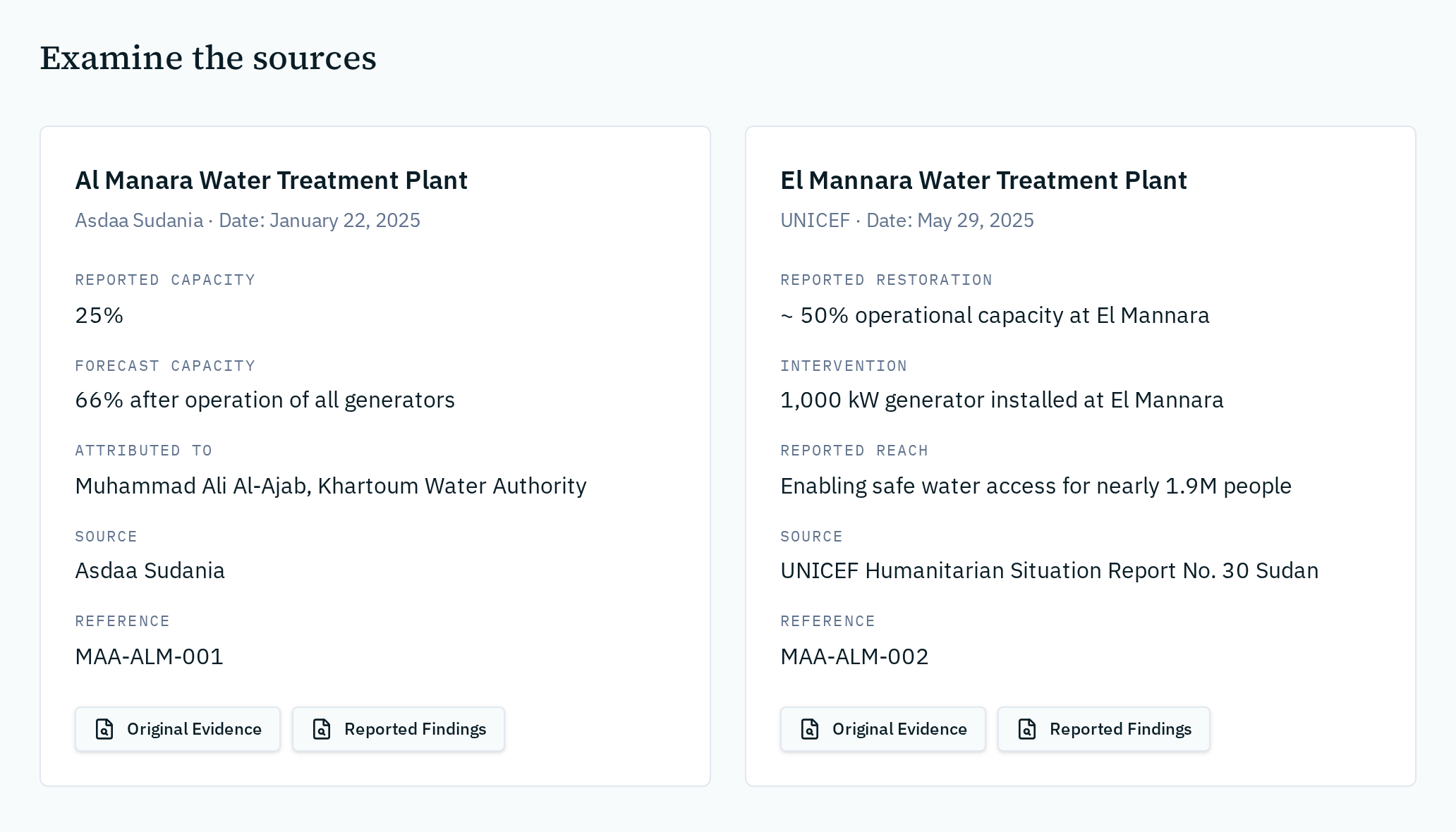
January 22, 2025 — Asdaa Sudania
Al Manara was reported to be operating at 25% capacity, with a forecast of 66% after all generators became operational. The report attributed these figures to Muhammad Ali Al-Ajab, Director of the Khartoum Water Authority.2
May 29, 2025 — UNICEF
El Mannara Water Treatment Plant was reported to have reached approximately 50% operational capacity, with one 1,000 kW generator installed and operating.3
The reports described work at the same water treatment plant, months apart. Their authors had different responsibilities and reasons for reporting. Neither report needed to account for the other.
A responder trying to restore service, or a funder deciding where to direct resources, might never encounter both.
We found them through a retrospective investigation. We checked the original sources, established that the different names referred to the same facility, and recorded the source packages and our findings on Geeq.
Imagine discovering those records while the work was still underway.
Suppose the organizations had contributed their records as they worked, making them available for others to discover and verify.
A responder searching for a water treatment plant finds reports from organizations they have never worked with. A funder sees what has been reported about the same facility, by whom, and when.
Neither has to wait for an introduction or ask someone to assemble the records. They can find the original reports, including the Arabic source, and check the evidence themselves, whenever they need it.
Participating organizations could contribute records through their own applications and processes, without having to establish a common reporting system or coordinate with everyone who might eventually use them.
Their records could inform decisions they never knew were being made.
Explore the Al Manara investigation
Explore the original source records, reported findings, and recorded receipts.
What are you trying to understand?
Some of the most consequential questions involve records held by different people and organizations.
Bring us a problem. Let's explore what we can build together.
Contact Settlement Infrastructure →Sources
- 1.
- 2.
- 3.
- 4.
- 5.
- 6.
- 7.